
A technical article published in Farmespaña Industrial explores how biological filtration could help livestock farms reduce ammonia emissions while recovering valuable nitrogen.
Ammonia emissions from livestock manure are not only an air quality concern, but they can also have adverse effects on human health and the environment. They represent also a loss of nitrogen from the agricultural system, a valuable nutrient that could otherwise support crop growth. ManuREfinery partner SYSPRO explores a technology to tackle both challenges in the 2026 special engineering edition of Farmespaña Industrial.
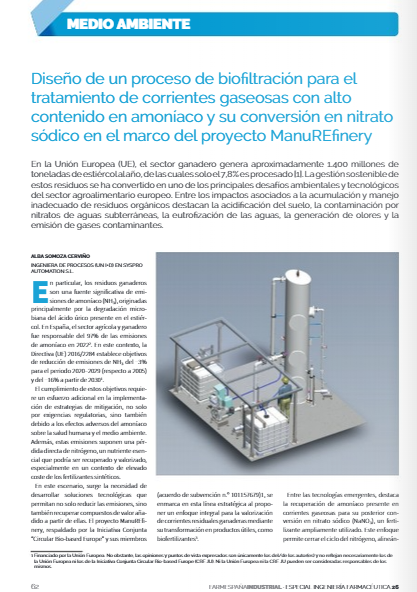
Turning Loss into a Resource
Written by engineer Alba Somoza Cerviño, the Spanish-language article, “Diseño de un proceso de biofiltración para el tratamiento de corrientes gaseosas con alto contenido en amoníaco y su conversión en nitrato sódico en el marco del proyecto ManuREfinery,” describes a biofiltration approach for ammonia-rich air from livestock operations. The idea is not to just remove the ammonia, but to isolate the nitrogen and produce a valuable liquid stream containing nitrate.
How does the technology work?
A biotrickling filter (BTF) is at the heart of the system. A stream of ammonia-rich air is introduced into the lower end of a packed reactor, and a stream of nutrient solution is trickled into the reactor through the packing material from the top. During this countercurrent contact, ammonia transfers into the liquid phase, where microorganisms growing in a biofilm on the packing material convert it biologically.
Bacteria transform the captured ammonia into nitrite and then into nitrate in a process that is known as nitrification. This yields a nitrate rich stream in the liquid phase which might be recovered and subsequently treated for the production of fertilisers. The design approach is to combine reduction of emissions with recovery of nutrients as one objective.
From Laboratory Research to Pilot-Scale Demonstration
The publication also includes insights gained from the laboratory that were used to inform the engineering design. It is a description of a reactor with an overall volume of 5 m³ and an operating liquid volume of about 500 l. High surface area packing allows microbial biofilm to grow. The system is intended to work at ambient temperature and pressure and has specific monitoring capabilities for pH, nutrient supply and conductivity, to support stable operation.
The nutrient solution is circulated through the packed bed by a recirculation loop, while porous Pall rings provide a large surface area for biofilm growth. A filtration step is inserted into a withdrawn liquid stream to remove the suspended solids. These features are designed to facilitate the gas–liquid contact and to prevent blockages during operation.
Operating conditions matter. Microorganisms require a suitable environment, but excessive biofilm growth can obstruct the packed bed, create uneven flow paths and increase pressure drop. The engineering design therefore addresses practical operating challenges alongside the underlying biological process.
What Happens Next?
Further pilot-scale testing will assess the system’s performance under real farming conditions. ManuREfinery plans to evaluate the technology at pig and poultry farms in Romania, where the conditions and ammonia concentrations may differ from those encountered in the laboratory. The team from the University of Valladolid (UVa) announced that the BTF pilot at the Romanian demonstration site was inoculated and started its initial operation in September 2026. Additional testing is needed to evaluate ammonia removal efficiency, nitrogen recovery and long-term operational stability.
By sharing its engineering approach in Farmespaña Industrial, SYSPRO is helping bring ManuREfinery research beyond the project consortium and into the wider engineering community. As the technology moves through real-world validation, this exchange of knowledge helps connect research with practical solutions for more sustainable livestock farming.
Original Publication
Alba Somoza Cerviño, Farmespaña Industrial, Especial Ingeniería Farmacéutica 2026, pp. 62–64.
https://farmaindustrial.com/revistas/especial-ingenieria-farmaceutica-2026/